Physical Address
304 North Cardinal St.
Dorchester Center, MA 02124
Physical Address
304 North Cardinal St.
Dorchester Center, MA 02124
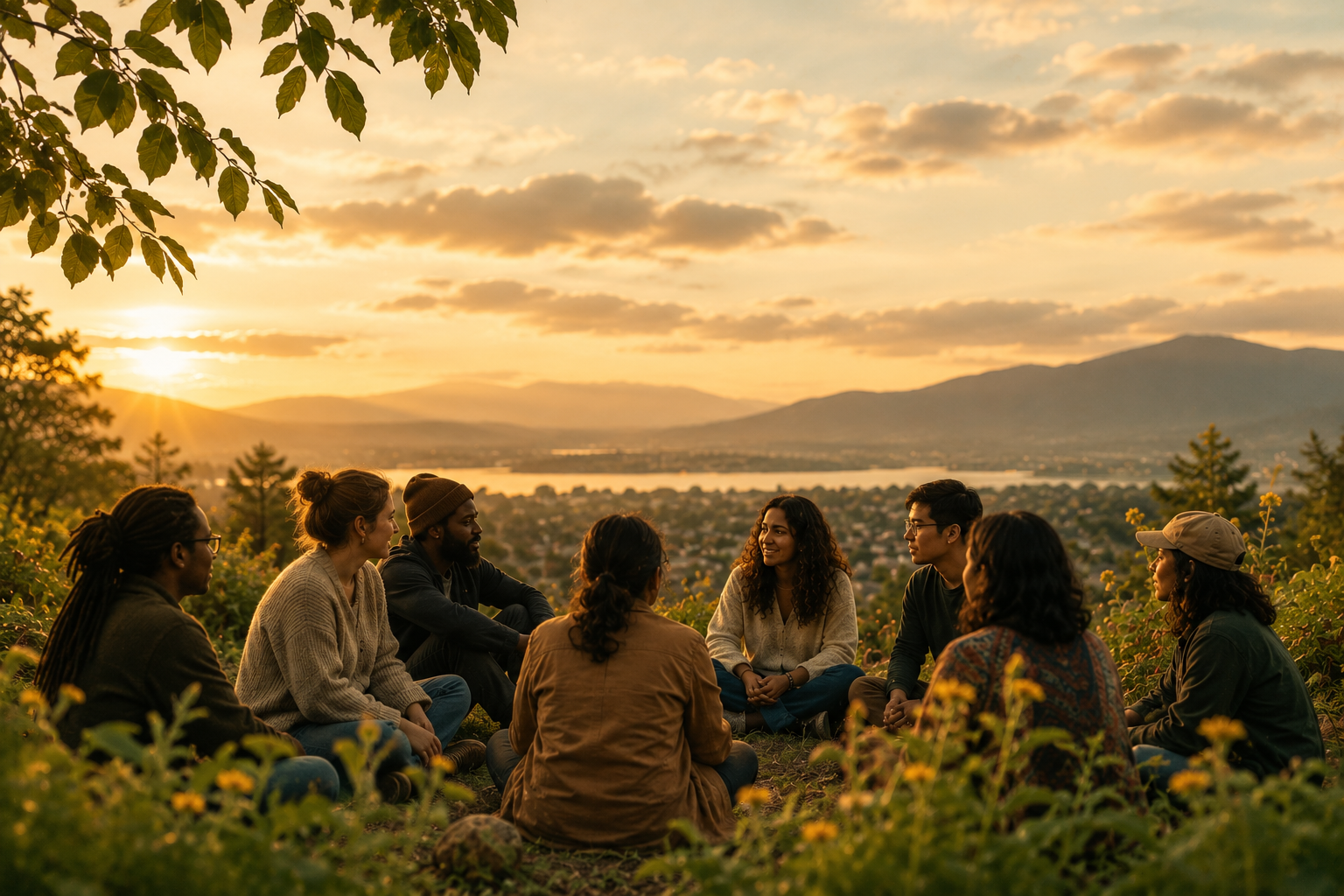
Down-to-Earth Solidarity invites communities to move beyond hierarchy, domination, boasting, and isolation toward mutual flourishing, ecological responsibility, and renewed relationships. Rooted in Romans 12:2, it asks how Christian learning can retrain perception, desire, and public life. What would it mean to learn solidarity together?
We are committed to recovering forms of Christian learning, community, and public life that move human beings away from hierarchy, domination, boasting, and isolation, and toward solidarity, mutual flourishing, and the renewal of creation.
Our work emerges from the conviction that the Kingdom of God is not merely about private spirituality or individual success. It concerns the transformation of relationships: between persons, communities, institutions, land, labor, animals, and the wider creation itself.
We believe many modern systems, including religious systems, often train people to measure worth through success, superiority, productivity, purity, caste, class, race, nationalism, gender hierarchy, or prosperity. These forms of formation shape how people see themselves and others. They produce cultures of comparison, exclusion, fear, extraction, and spiritualized meritocracy.
We seek another way.
Drawing especially from the Epistle to the Romans, historical-critical biblical scholarship, anti-imperial interpretation, feminist and anti-caste thought, ecological ethics, and transformative pedagogy, we explore how communities can be formed through practices of mutual care, intellectual humility, hospitality, and shared flourishing.
We call this vision:
Down-to-Earth Solidarity is the movement away from systems that elevate some by diminishing others. It resists the belief that human worth must be earned through status, visibility, wealth, purity, competition, or domination.
Instead, it asks how communities can learn to live through:
This vision is deeply shaped by the insight that transformation is not merely personal. Human beings are formed socially, visually, economically, politically, and spiritually. Public life teaches people how to desire, judge, compete, exclude, and aspire. Because of this, transformation must also be communal and pedagogical.
Romans 12:2 names this struggle clearly:
“Do not be conformed to this world, but be transformed by the renewing of your minds” (NIV).
We understand this renewal not as withdrawal from the world, but as the difficult relearning of perception, desire, responsibility, and shared life.
Many contemporary Christian cultures shaped by prosperity theology and merit-based spirituality reinforce binary hierarchies of strong and weak, blessed and unblessed, worthy and unworthy. These systems train communities to measure human value through success, visibility, purity, wealth, or spiritual achievement.
Down-to-Earth Solidarity seeks to interrupt these forms of formation by cultivating epistemic hospitality: practices of listening, humility, mutual learning, and shared vulnerability that resist systems of superiority and exclusion.
Through epistemic hospitality, communities can begin nurturing relational prosperity grounded not in competition or upward mobility, but in mutual flourishing, shared dignity, and communal responsibility.
This movement ultimately widens toward human–nature kinship, where ecological life is no longer treated as disposable, but as part of a shared and interdependent world.
Our work focuses especially on:
We challenge forms of prosperity that reduce blessing to wealth, upward mobility, success, or visibility. We explore forms of flourishing rooted instead in mutual care, shared dignity, restorative relationships, and communal well-being.
Creation is not a backdrop for human ambition. Land, water, animals, laboring bodies, and ecosystems are bound together in shared vulnerability and shared hope. Ecological destruction and social domination are often interconnected.
Communities are always teaching people how to think, desire, fear, judge, and belong. We examine how education, religion, media, empire, caste, and institutions shape consciousness, and how communities can cultivate practices of critical awareness, empathy, and solidarity instead.
We read biblical texts within their historical and political worlds, especially the Roman Empire. We explore how early Christian communities struggled with hierarchy, boasting, exclusion, ethnic division, gendered power, and public honor systems, many of which continue in new forms today.
We are especially attentive to the enduring realities of caste, social stratification, and systems of inherited inequality. We seek forms of theological and communal formation that resist exclusionary structures and nurture shared humanity.
We live in a world marked by deep fragmentation:
In such a world, communities need more than inspiration. They need practices of transformation.
They need ways of learning how to live together differently.
They need forms of public theology capable of speaking to institutions, classrooms, churches, movements, and everyday life.
This site exists to contribute to that work.
This space brings together:
The goal is not simply to interpret texts, but to ask:
What kinds of people and communities are we becoming?
And:
What forms of life make shared flourishing possible?
We hope to participate in forms of learning and public life that nurture:
We believe another way of inhabiting the world is possible.
And we believe communities can learn it together.