Physical Address
304 North Cardinal St.
Dorchester Center, MA 02124
Physical Address
304 North Cardinal St.
Dorchester Center, MA 02124

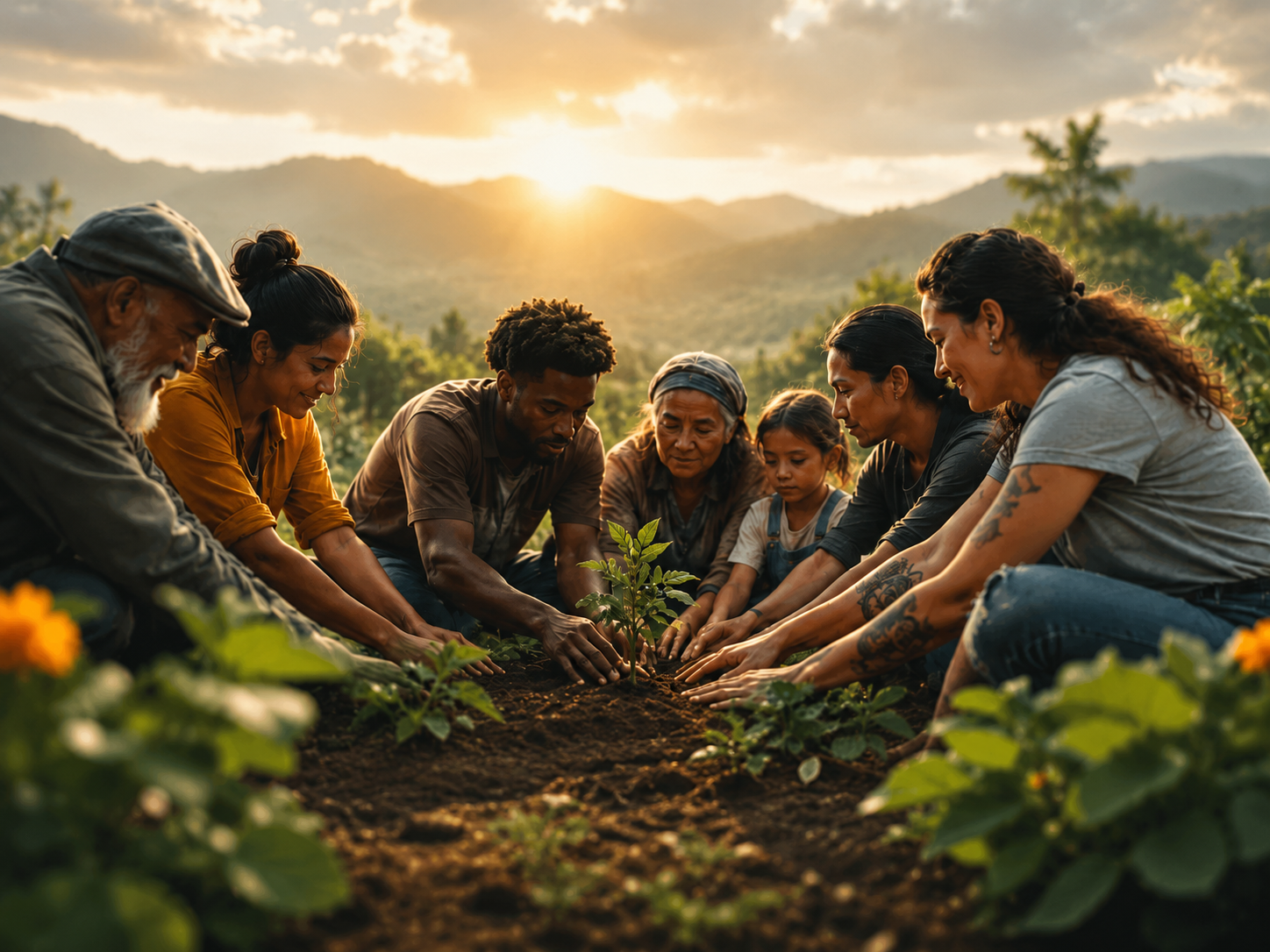
Down-to-Earth Solidarity questions the ladders of worth that train people to climb above others through wealth, power, purity, visibility, or success. Rooted in Romans 12:2, it invites communities to relearn how to live through humility, mutual responsibility, relational prosperity, and human–nature kinship. It is a call to resist domination and practice shared flourishing on earth.
We live in a world that constantly teaches people to climb.
Climb higher.
Become more successful.
Become more visible.
Become more productive.
Become more powerful.
Become more pure.
Become more respected.
Become more prosperous than others.
Entire societies are organized around these ladders of worth. Schools, economies, political systems, social media, religious institutions, and even families often train people to measure human value through comparison and hierarchy.
Some rise.
Others are pushed downward.
Many religious systems unintentionally reinforce the same logic. Blessing becomes associated with wealth, influence, achievement, or moral superiority. Suffering becomes interpreted as failure, weakness, lack of faith, or divine disfavor. Communities begin dividing people into categories of successful and unsuccessful, pure and impure, worthy and unworthy, strong and weak.
Down-to-Earth Solidarity begins by questioning these ladders.
It asks whether human flourishing can exist without systems that require some people to stand above others.
It asks whether communities can learn forms of life rooted not in domination, competition, or superiority, but in mutual responsibility, relational dignity, and shared flourishing.
The phrase “down-to-earth” is important.
It points first to humility. Human beings are not self-made gods climbing endlessly upward. We are vulnerable creatures bound to one another and to the earth itself. We depend on labor, water, food, ecosystems, relationships, and communities that sustain life. Down-to-earth solidarity therefore resists fantasies of limitless self-sufficiency and individual triumph.
But the phrase also points to social reality.
Many systems teach people to distance themselves from those considered “lower”: the poor, the stigmatized, migrants, manual laborers, marginalized castes, racialized communities, disabled persons, the elderly, or anyone marked as weak within dominant cultures. Modern societies often reward separation from vulnerability rather than solidarity with it.
Down-to-earth solidarity moves in the opposite direction.
It asks what happens when communities learn to move toward one another rather than away from one another.
This vision has deep roots in the Epistle to the Romans. In Romans 12:2, Paul writes:
“Do not conform to the pattern of this world, but be transformed by the renewing of your mind” (NIV).
This transformation is often reduced to private spirituality or personal self-improvement. But Romans itself points toward something much larger. Paul addresses communities struggling with hierarchy, ethnic tension, judgment, superiority, exclusion, and conflicts between strong and weak. He repeatedly challenges boasting, status-seeking, and the desire to elevate oneself over others.
The renewal of the mind therefore concerns communal perception.
It concerns how people learn to see one another.
Will communities organize themselves around ranking, exclusion, purity, visibility, wealth, and power? Or can they learn forms of shared life grounded in welcome, mutual care, patience, hospitality, and responsibility?
This is why down-to-earth solidarity is also a pedagogy.
Human beings are formed by the worlds they inhabit. Public life teaches people how to desire, fear, judge, aspire, and belong. Empires teach through spectacle. Markets teach through competition. Social hierarchies teach through shame and aspiration. Religious systems also teach, sometimes nurturing compassion, and sometimes reinforcing superiority.
Transformation therefore requires relearning.
Communities must learn how to resist systems that normalize domination and human inequality. They must cultivate intellectual humility, critical awareness, empathy, ecological responsibility, and practices of shared flourishing.
This includes rethinking prosperity itself.
Modern prosperity cultures often define flourishing through accumulation, upward mobility, visibility, or personal success. Down-to-earth solidarity proposes another vision: relational prosperity.
Relational prosperity asks whether flourishing can be measured through restored relationships rather than competitive achievement. A community may become prosperous not because a few individuals rise above others, but because people learn to care for one another, share burdens, resist exploitation, and protect the conditions that sustain life.
This vision also extends beyond human beings alone.
Human–nature kinship recognizes that social violence and ecological destruction are deeply interconnected. Systems that exploit land, water, labor, and animals often rely on the same logic that treats vulnerable human beings as disposable. Ecological renewal therefore cannot be separated from social transformation.
Down-to-earth solidarity is not a utopian fantasy that ignores conflict or suffering. It begins from the recognition that human communities are deeply fractured by hierarchy, domination, extraction, and fear. But it insists that another way of inhabiting the world is possible.
It asks difficult questions:
What kinds of people are our institutions forming?
What forms of success are we teaching others to desire?
What happens to communities when worth is measured through competition and superiority?
What forms of life become possible when people learn to bear one another’s burdens instead?
These questions matter not only for churches, but also for schools, political systems, economies, ecological movements, and public life itself.
Down-to-earth solidarity is therefore not merely a theory.
It is an invitation to relearn how to live together.